dogs behavior change: Why It Happens and How to Help
- ericavdippold
- Oct 29, 2025
- 17 min read

When your dog suddenly starts acting differently, it’s not because they're being “bad.” A sudden dogs behavior change is their most direct way of telling you something’s wrong. It could be physical pain, stress from their environment, or just a natural part of getting older.
Your job is to switch from a worried owner to a patient detective, learning to read their signals to figure out what they’re trying to say.
Decoding Your Dog's Sudden Behavior Change
Hey there, fellow dog lover. As someone who runs a doggy daycare, I've met more canine personalities than I can count. I also know that sinking feeling in your stomach when you realize your best friend just isn't acting like themselves.
One minute, they're the same happy-go-lucky pup, and the next, they're suddenly anxious, hiding away, or maybe even a little snippy. It’s scary, for sure. But the most important thing to remember is that this is communication. It's their way of waving a big red flag.
So, before you panic, take a breath. It’s time to start observing. Think of yourself as a detective, piecing together clues to understand what’s happening in your dog’s world.
The single most important behavior to watch for in your dog is simply change. Dogs are creatures of habit, so any deviation from their normal routine is a powerful sign that something deeper is going on.
But where do you start looking for answers? The possibilities almost always fall into one of three buckets. Let's break them down.
The Three Main Causes of Behavior Shifts
Physical Pain or Discomfort: More often than not, a medical issue is the culprit behind a behavior problem. A nagging ear infection, the quiet onset of arthritis, or a painful tooth can easily turn the sweetest dog irritable or make them hesitant to be touched.
Environmental or Social Stress: Dogs are sponges for their environment. A new baby joining the family, a shift in your work schedule, or even the loud construction happening next door can trigger anxiety that manifests as a brand-new behavior.
Age-Related Development: Just like us, dogs navigate different life stages. A rebellious "teenage" phase around 6-18 months or the cognitive fog that can accompany old age will naturally change how they act.
This infographic gives you a great visual for how to approach the mystery of your dog's behavior change.
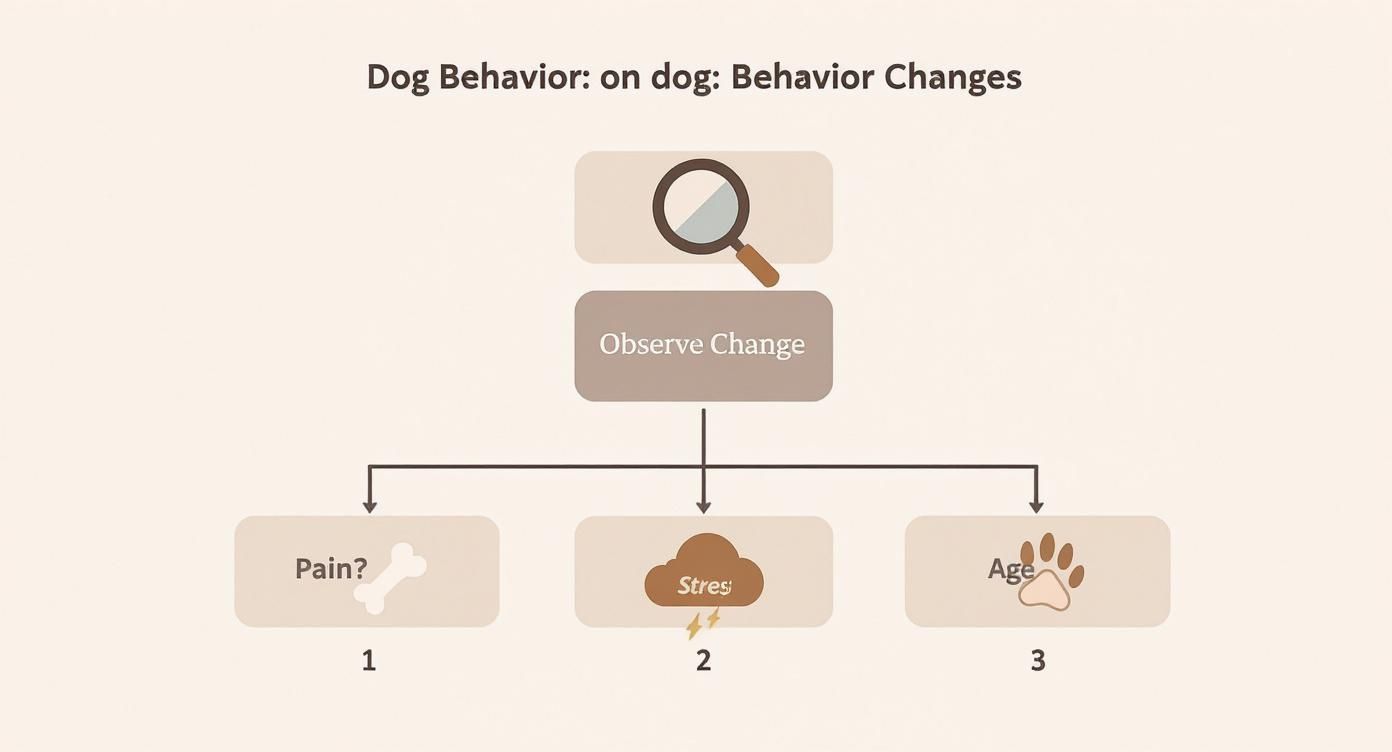
As you can see, your first move is always to observe. From there, you can explore whether pain, stress, or age is the likely cause. To help you connect the dots, I’ve put together a quick reference table.
Common Behavior Changes and What They Might Mean
This table is a great starting point to help you connect a new behavior with its potential cause, giving you a clear direction for your investigation.
Observed Behavior Change | Potential Medical Causes | Potential Environmental or Social Causes |
|---|---|---|
Sudden Aggression or Irritability | Dental pain, arthritis, injury, neurological issue, hypothyroidism | Fear, resource guarding, new person/pet in the home, feeling threatened |
Increased Clinginess or Separation Anxiety | Vision or hearing loss, cognitive decline (in older dogs) | Change in routine, moving to a new house, loss of a family member (human or pet) |
Hiding or Withdrawal | Illness, pain, nausea | Frightening event (like fireworks), new stressful stimuli, lack of a safe space |
Inappropriate Urination or Soiling | Urinary tract infection (UTI), kidney disease, diabetes, incontinence | Stress, anxiety, changes in household dynamics, marking new territory |
Loss of Appetite | Dental problems, gastrointestinal upset, systemic illness | Stress, anxiety, change in food, new environment |
Pacing or Restlessness | Pain, cognitive dysfunction (sundowning), bloating (GDV) | Boredom, lack of exercise, anxiety, loud noises |
Remember, this is just a guide. The key is to see these changes as clues, not just problems.
Learning to interpret these signals is a huge part of the puzzle. If you want to dive deeper, you can check out our guide to understanding dog body language. Now, let’s explore each of these causes in more detail so you have a solid framework for figuring out what’s going on with your furry family member.
Why a Vet Visit Is Your First Step
Here at the daycare, I have a golden rule I share with every single owner who mentions a sudden dog behavior change: before you do anything else, call your vet. It's the most important—and most loving—first step you can possibly take.
I can’t count the number of times I’ve seen well-meaning owners spend a fortune on trainers or completely rearrange their homes, only to find out weeks later that the real problem was a hidden medical issue. Your dog can't just tell you, "My tooth really hurts," or "My ear is ringing." Instead, they show you through their actions.
What we often interpret as a "behavior problem" is actually a cry for help. A sudden reluctance to be petted on the head might not be stubbornness; it could easily be a painful ear infection. That new grumpiness on walks? It could be the early signs of arthritis, making every step a real chore. Ruling out a physical cause is simply non-negotiable.
Pain: The Silent Behavior Changer
Pain is one of the biggest culprits behind a sudden shift in a dog's personality. Dogs are absolute masters at hiding discomfort—it's a deep-seated survival instinct—so by the time their behavior changes, the problem might already be quite advanced.
Think about it: if you had a pounding headache, you'd probably be irritable, unsociable, and just want to be left alone. It's no different for our dogs.
A study on aggression in dogs found that a significant number of cases had an underlying medical component, with pain being a primary factor. The connection is so strong that vets often consider pain a top differential diagnosis for any new aggressive behaviors.
Consider these all-too-common pain-related scenarios:
Dental Disease: A sore tooth or infected gums can make a dog suddenly head-shy, unwilling to eat their kibble, or irritable whenever their face is touched.
Arthritis or Joint Pain: This is a huge one, especially in older dogs. It can lead to a refusal to go on walks, difficulty getting up, or even a growl when you try to move them.
Ear or Skin Infections: That constant, nagging irritation can make a dog restless, sensitive to touch, and just plain cranky.
When you see your vet, be ready to describe the specific changes you’ve noticed. Instead of saying, "He's being aggressive," try something like, "He growled at me yesterday when I touched his lower back." This kind of detail gives your vet a clear place to start their investigation.
Beyond Pain: Hormones and Other Hidden Issues
While pain is a major player, other medical conditions can completely alter a dog's behavior. These issues often fly under the radar because they don't cause obvious physical discomfort, but they can wreak havoc on your dog's mood and personality from the inside out.
Hormonal imbalances are a perfect example. Just like with us, a dog's hormones regulate everything from their energy levels to their mood.
Common Medical Conditions Affecting Behavior:
Hypothyroidism: An underactive thyroid is surprisingly common in dogs. It can cause lethargy and weight gain, but also, sometimes, uncharacteristic aggression or anxiety.
Canine Cognitive Dysfunction (CCD): Often called "doggy dementia," this condition affects senior dogs, leading to confusion, disorientation, changes in sleep patterns, and house-soiling accidents.
Neurological Problems: Issues like seizures (which can be very subtle) or even brain tumors can cause dramatic and bizarre behavioral shifts, from pacing aimlessly to sudden, unexplained aggression.
Vision or Hearing Loss: As a dog's senses fade with age, they can become more easily startled. This can lead to increased anxiety or defensive reactions that seem to come out of nowhere.
Your veterinarian is your most important partner in solving this puzzle. By performing a thorough physical exam and maybe running some blood tests, they can rule out these medical causes. Only after your dog gets a clean bill of health should you start exploring environmental or training-based solutions. It’s the responsible, effective, and compassionate place to begin.
How Your Dog's Age Shapes Their Behavior
Once you’ve had your vet rule out any health problems, the next place to look is your dog's age. I see dogs of all life stages here at the daycare, and trust me, a six-month-old puppy and a ten-year-old senior are living in two completely different worlds. A dog's behavior change is often just a normal, predictable part of growing up and growing older.
Think about it—we don't expect a toddler to act like a teenager, or a teenager to act like a retiree. The same goes for our dogs. The clumsy, needle-toothed puppy chewing on your coffee table will one day become the wise old soul who just wants to find the perfect sunbeam for a nap. Knowing what’s normal for their age helps you understand what's going on and provide the right support.
The Puppy Phase: A Whirlwind of Learning and Energy
Those first few months are chaos, but in the best way. Puppies are basically little sponges, soaking up every sight, sound, and smell. Their job description is simple: play, explore (usually with their teeth!), and figure out the rules of their new world.
You're dealing with boundless energy packed into a tiny body with a very short attention span. It's totally normal for them to be over-the-top excitable and seem to forget everything you just taught them. Patience and consistency are your two best friends right now. For a much deeper look, we have a whole guide to puppy training and socialization that breaks this crucial period down.
The Teenage Rebel: Surviving Dog Adolescence
And then comes adolescence. If you've ever thrown your hands up and said, "What happened to my perfectly trained puppy?" you're probably in the thick of it. This phase usually hits somewhere between six and eighteen months, and it’s often the single most challenging time for owners.
Their hormones are going wild, and their brain is undergoing a massive renovation. It’s almost like the part of their brain responsible for impulse control just goes offline for a while.
During adolescence, a dog's brain is literally restructuring. This neurological chaos can cause a sudden drop in obedience and a big spike in boundary-testing, even in a previously well-behaved dog.
You’ll probably recognize a few of these classic teenage moves:
Selective Hearing: That "come" command they knew perfectly last week? Suddenly, it’s like they’ve never heard it before in their life.
Pushing Boundaries: They might start doing things they haven't done in months, like jumping on the counters or chewing on the furniture again.
A Newfound Independence: The cuddly pup who never left your side might now seem way more interested in sniffing a single patch of grass for ten minutes than listening to you.
As frustrating as it is, this is a completely normal developmental stage. Just stay consistent with your training and rules. I promise, this phase does pass!
Adulthood and Senior Years: Settling In and Slowing Down
Once dogs move into full-fledged adulthood, things tend to even out. Their personalities are more stable, their energy is more predictable, and they’ve got the household routine down pat. This is often the golden age of dog ownership, where your bond is rock-solid.
But as they ease into their senior years, new changes can pop up. Just like people, older dogs start to slow down. They might sleep more, lose interest in those marathon walks, or become a bit more stubborn. This is also when we might see the first signs of Canine Cognitive Dysfunction (CCD)—think of it as doggy dementia. This can lead to confusion, new anxieties, or even accidents in the house.
Of course, age isn't the only factor. Breed plays a huge role in how a dog’s personality develops over time. Large-scale studies have uncovered some fascinating patterns. For example, some research shows that smaller dogs tend to be more fearful of new things. This same research has also started to question old beliefs, suggesting that spaying or neutering can sometimes increase fear and aggression instead of calming a dog down, which is food for thought. You can read more about how dog behavior changes with age and breed on vice.com.
By understanding these life stages, you can anticipate your dog’s changing needs and meet them with empathy, keeping your bond strong through every single year you have together.
Uncovering Environmental and Social Triggers
Okay, now that we’ve ruled out medical causes and looked at your dog’s age, it’s time to put on our detective hats. As a doggy daycare owner, I often see that dogs are like highly sensitive barometers—they react to every little shift in the atmosphere of their world. A sudden change in a dog’s behavior is very often a direct response to something in their environment or social circle.
What feels like a minor tweak to our routine can feel like a seismic event to our dogs. They build their whole sense of security on predictability, so when their world gets shaken up, their behavior is often the first thing to show the cracks.
Spotting the Big Changes
Some triggers are pretty easy to connect the dots on. These are the major life events that completely rearrange your dog's daily reality. If you've recently gone through one of these, it's a prime suspect for your dog's new behavior.
Moving to a New Home: Suddenly, nothing smells, sounds, or looks the same. This can be incredibly disorienting and stressful for a dog trying to find their footing.
A New Family Member: Whether it's a newborn baby or a new partner moving in, the entire social dynamic of the house has been rewritten.
A New Pet: This is a huge one. Bringing another animal into the home can spark jealousy, territorial disputes, or outright fear.
Changes in Your Schedule: Did you start a new job? Are you suddenly working from home less often? A major shift in your daily routine forces a shift in theirs, and that can be very unsettling.
Think of it this way: Imagine you came home one day and all your furniture was rearranged, a stranger was living on your couch, and your work hours were completely flipped. You’d be stressed out, right? That’s exactly what these big shifts can feel like for your dog.
The Subtle Stressors You Might Overlook
While those big events are often obvious, sometimes the cause of a behavior change is much more subtle. These are the quiet, background stressors that can build up over time, eventually boiling over into a noticeable problem.
It’s our job to try and see the world through their eyes—and ears, and nose—to find these hidden triggers.
A dog’s world is built on patterns. When that foundation is shaken by new sounds, sights, or schedules, it creates an undercurrent of stress that can bubble up as anxiety, fear, or even aggression.
Here are a few common culprits that often fly under the radar:
Construction Noise: That constant drilling, banging, and beeping from the construction site next door can be torture for a dog with sensitive hearing.
A New Dog on Your Walking Route: If a territorial, reactive dog has moved in down the street, your daily walk may have gone from a fun adventure to a minefield of stress.
A Change in Family Dynamics: Dogs are incredibly attuned to our emotions. Increased tension or arguments in the household can make them feel anxious and insecure.
Even massive societal shifts can have a surprising impact. A fascinating study by Virginia Tech researchers analyzed data from over 47,000 dogs and found that while most behaviors stayed consistent, dogs enrolled in the study after 2020 showed lower trainability scores. This hints that the widespread stress and routine changes of the pandemic might have influenced how effectively owners could train their new companions. You can explore the full study on dog behavior analysis to dig into how dogs and their people adapted.
Creating a Stable and Secure World
So, what can you do about it? Your main goal is to restore a sense of predictability and safety for your dog. Your most powerful tool here is a consistent routine. Try to keep feeding times, walks, and playtime as regular as you possibly can.
It's also crucial that your dog has a "safe space"—like a crate or a cozy bed in a quiet corner—where they can go to decompress when they feel overwhelmed. This is their personal sanctuary, a place where they know they won't be bothered.
Finally, enrichment activities like puzzle toys and scent work are fantastic for building confidence. They give your dog a "job" to focus on, which naturally reduces anxiety and helps them feel more capable of handling life's little curveballs. By giving them some control over their environment, you help them regain control of their emotions.
Gentle Strategies for Managing Problem Behaviors
So, you've played detective. You've had the vet rule out any underlying medical problems and you’ve considered how your dog’s age or environment might be sparking a dogs behavior change. Now for the part where we get to roll up our sleeves and actually help them. This is where the real connection happens, and where we build a rock-solid foundation of trust.
First, let’s be clear about what we won’t be doing. We are completely leaving old-school, punishment-based tactics in the past. Yelling, shock collars, or forcing a dog to “face their fears” simply don’t work. In fact, they almost always backfire, piling more fear and anxiety on top of the original problem.
Instead, our entire approach is built on modern, science-backed methods that focus on one thing: changing the emotion that’s driving the behavior. Think of it less as "fixing a bad dog" and more as helping your dog feel safe and confident in their world again.
The Power of Positive Reinforcement
At its core, positive reinforcement is incredibly simple. You reward the behaviors you want to see more of. This isn't about bribing your dog—it's about teaching them that good choices lead to good things. It’s the cornerstone of all effective and humane dog training today.
When a dog is acting out from a place of fear or stress, positive reinforcement helps you rewrite their internal script. It creates a brand-new, happy association with something that used to feel overwhelming.
Turning a Negative Into a Positive
Two of the most powerful tools we have for this are desensitization and counter-conditioning. They sound technical, but I promise the concepts are straightforward and almost always used together.
Desensitization (DS): This is all about gradually exposing your dog to their trigger, but at such a low level that they don't have a big reaction. The goal is to stay "sub-threshold," meaning the scary thing is far enough away or quiet enough that your dog can notice it without panicking.
Counter-Conditioning (CC): Here’s where the magic happens. While you’re exposing your dog to that very low-level trigger, you pair it with something they find absolutely fantastic, like tiny pieces of chicken, cheese, or whatever their favorite high-value snack is.
The real aim of counter-conditioning isn’t just to distract your dog. It’s to fundamentally change their emotional response. Over time, their brain literally forges a new pathway: "That scary thing I see now predicts that amazing food is coming my way!"
Let’s make this real. Say your dog is terrified of the vacuum cleaner.
Start Small (Desensitization): Begin by just having the vacuum in the corner of the room, turned off. The second your dog looks at it without getting tense, toss them a super tasty treat. Then, put the vacuum away. Session over.
Build a New Association (Counter-Conditioning): Repeat this over several short sessions. The vacuum's mere presence now starts to predict delicious snacks.
Slowly Up the Ante: Once your dog is totally relaxed, you might move the vacuum a foot closer. Treat and praise. In a later session, you might touch the vacuum. Maybe you turn it on for a single second in another room. Each step is tiny and always paired with a fantastic reward.
This patient, gentle process helps your dog build a positive feeling about the vacuum. We’re not forcing a confrontation; we’re changing their mind, one high-value treat at a time. This exact same approach works for fear of strangers, other dogs, and all sorts of anxieties. Separation anxiety can be especially challenging, which is why we've put together a dedicated guide on how to reduce dog separation anxiety with more specific strategies.
If you’re feeling overwhelmed by all this, you are far from alone. One major study found that nearly 99.12% of dogs show at least one behavioral issue. Aggression was noted in 55.6% of dogs, with fear and anxiety impacting almost half of them. These numbers show just how normal these struggles are. The most important thing to remember is that with patience and the right approach, you can absolutely make a world of difference for your dog.
Knowing When to Call a Professional
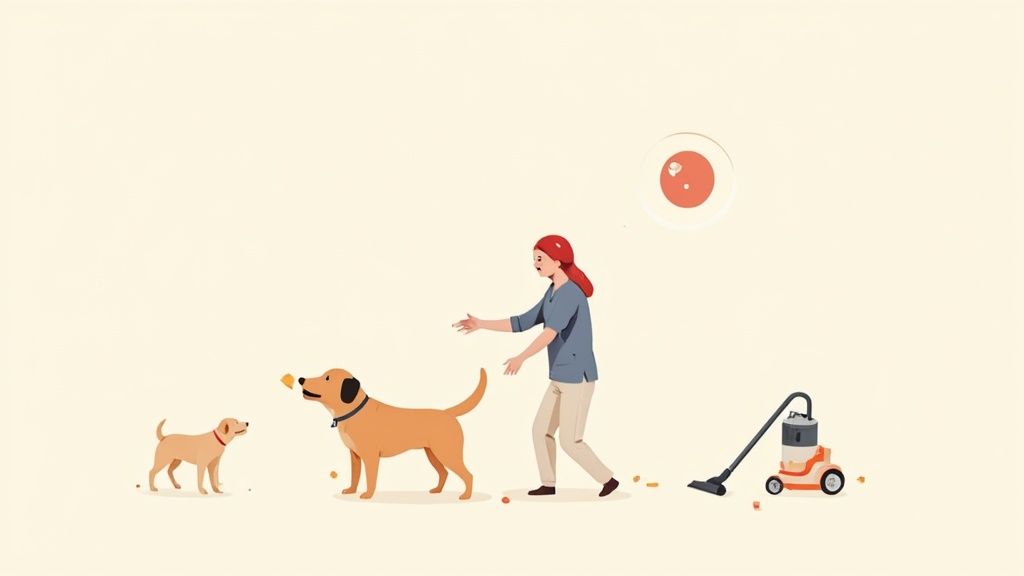
As someone who's spent years running a doggy daycare, I can tell you my favorite clients are the ones who aren't afraid to ask for help. Recognizing that a dog's behavior change is more than you can handle isn't a sign of failure—it's a sign of incredible strength and love for your dog. Sometimes, the situation is just too complex or severe to tackle on our own, and that’s completely okay.
Getting the right expert on your team can be an absolute game-changer. The world of dog professionals can feel a bit confusing, though. Knowing who to call for what is the first, most important step toward getting your dog the support they truly need.
Who to Call for Help
Not all dog professionals are the same; each has a very specific area of expertise. It helps to think of it like human medicine—you wouldn't see a cardiologist for a broken bone. You need the right specialist for the job.
Here’s a quick breakdown of who's who in the dog world:
Certified Dog Trainer: This is your first stop for obedience issues and common behavior problems. Think leash pulling, jumping on guests, or just general manners. They are experts at teaching you and your dog new skills using positive reinforcement.
Certified Animal Behaviorist (CAAB): These professionals typically have advanced degrees in animal behavior. You'd call them for more complex issues like severe anxiety, deep-seated phobias, or compulsive behaviors. Their job is to dig into the deep "why" behind what's happening.
Veterinary Behaviorist (DACVB): This is a veterinarian who has specialized in behavior. They are the only ones who can prescribe medication, making them essential for cases where medication might be needed alongside a training plan. This includes things like clinical anxiety, panic disorders, or severe aggression.
Knowing when to escalate is key. If your dog's behavior involves aggression, self-harm, or severe anxiety that isn't improving, it’s time to move beyond basic training and consult with a behaviorist.
Finding the Right Professional
Once you know what kind of help you need, the next challenge is finding a qualified person you can trust. You're looking for someone who uses modern, humane, and science-backed methods—specifically, a commitment to positive reinforcement.
Be on the lookout for red flags. Anyone guaranteeing a "quick fix" or promoting punishment-based tools like shock collars, prong collars, or choke chains should be avoided. These harsh methods might suppress a behavior in the short term, but they almost always make the underlying issue worse and can seriously damage your dog's trust in you.
When you find someone who seems like a good fit, don't be shy about asking questions! A true professional will be happy to walk you through their methods, experience, and qualifications.
Preparing for Your First Session
To get the most out of your first consultation, a little prep work goes a long way. If you can, try to safely get some video of the problem behavior as it's happening. It’s also incredibly helpful to keep a simple journal for a few days leading up to the appointment.
Jot down when the behavior occurs, what was happening right before it started, and how you responded. This information is pure gold for a professional. It gives them a clear, objective window into your dog’s world, helping them build a much more effective and personalized plan for you and your best friend.
Common Questions About Dog Behavior Change
After years of running the daycare, I’ve heard just about every question you can imagine from worried dog parents. When you're suddenly faced with a dogs behavior change, it’s completely natural to have a million things racing through your mind. Let's walk through some of the most common ones I hear.
How Long Does It Take to Fix a New Behavior in My Dog?
This is the big one, and the honest-to-goodness answer is: there's no magic timeline. How quickly things improve really depends on the individual dog, the specific behavior, and what’s actually causing it in the first place.
If the problem is medical, you might see a wonderful turnaround almost as soon as the vet starts the right treatment. But for behaviors that come from a place of deep-seated fear or anxiety, progress is usually a "slow and steady wins the race" kind of deal. The most important thing you can do is stay consistent and be incredibly patient with your pup.
Remember, you're not just trying to stop an action; you're helping your dog change how they feel about a situation. That kind of emotional work takes time—sometimes weeks, sometimes months of dedicated, positive training. Focus on celebrating the small wins along the way, not on hitting some imaginary finish line.
Can My Stress Affect My Dog's Behavior?
Oh, absolutely. Dogs are masters at reading our emotions. They are incredibly sensitive to our stress and can pick it up from the slightest tension in our voice, our body language, or even our scent.
If you're going through a stressful time, your dog might become more anxious or reactive as a direct result. That’s why managing our own stress and trying to be a calm, confident leader for our dogs is so crucial. Seriously, just taking a few deep breaths before you start a walk or a training session can make a world of difference for both of you.
Is It Ever Too Late to Address a Long-Term Behavior Problem?
It is never too late to help your dog. While it's true that shaping behavior in a young puppy can be easier, adult and senior dogs are always capable of learning and changing.
Your approach might need to be a bit different, and you'll definitely need an extra dose of patience to help undo habits that have been around for a while. But positive change is always possible. The key ingredients are understanding the root cause, committing to positive reinforcement, and being consistent. An old dog can absolutely learn new ways of feeling about their world.
If you're in the King of Prussia area and need a safe, loving place for your dog to stay and play, our team at Pawcation would love to help. We offer daycare and boarding with the personal touch of a home environment. You can check out our services to learn more.
Comments