Understanding a Change in Dog behavior: A Guide from Your Dog's Second-Best Friend
- ericavdippold
- Oct 17, 2025
- 17 min read

Hey there, fellow dog lover. When your dog's behavior suddenly flips on a dime, it’s often their first—and sometimes only—way of telling you something is wrong. They can’t sit us down for a chat, so their actions have to do all the talking. As a dog parent, learning to read these signals is one of the most important things you can do for your furry family member.
Why Your Dog Is Suddenly Acting Different
As someone who runs a doggy daycare, I get this question all the time: "Why is my dog suddenly acting so strange?" It's a question that’s always loaded with worry because you know your dog better than anyone. One minute, they’re their normal, happy-go-lucky self, and the next, they might be oddly quiet, anxious, or even a little grumpy. It's a jarring experience for any of us.
Dogs are total creatures of habit. They love their routine—the same walk time, the same favorite nap spot, the same tail-wagging dance when you walk in the door. When that predictable pattern shatters, it's a huge red flag. Think of their typical behavior as a baseline; any sudden shift away from that baseline is your cue to put on your detective hat.
The Core Reasons for Behavioral Shifts
A sudden change in a dog's behavior rarely happens for no reason. In my experience, you can almost always trace it back to a handful of core causes. These shifts are your dog's way of telling you that something in their world has been turned upside down, and they need your help to sort it out.
This infographic breaks down the three main areas we look at first when a dog starts acting out of character.
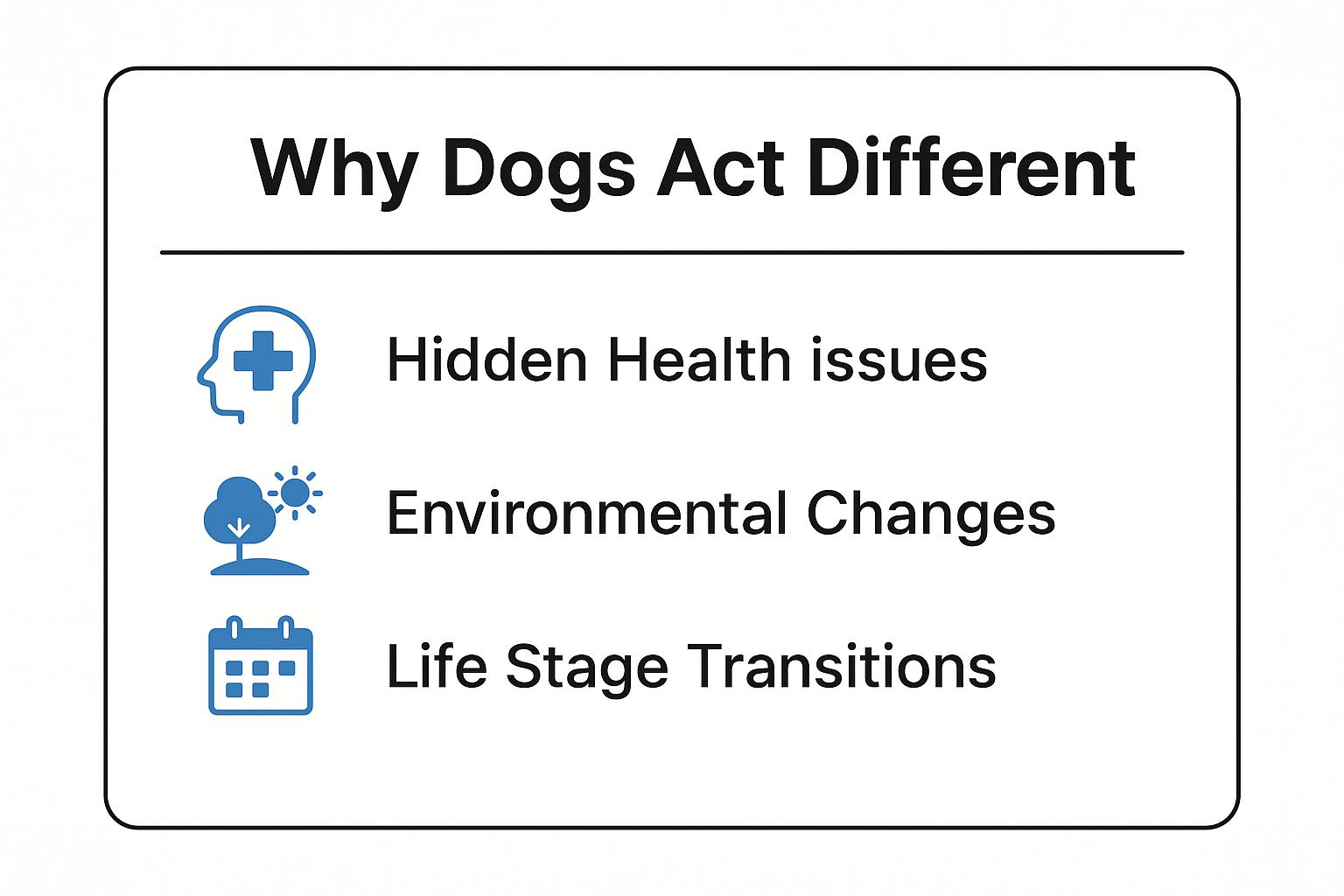
This visual really simplifies the puzzle. It shows that most behavioral changes are driven by either a hidden health problem, a shift in their environment, or a natural transition to a new life stage.
So, before you jump to the conclusion that your dog is just being "bad," we can start by looking at these possibilities. Could something be physically hurting them? Did something at home change, like a new schedule or a new family member? Or are they just navigating a new phase of life, like their rebellious teenage months or their golden senior years?
The most important thing you can watch for is change itself. Because dogs are so consistent, any change in behavior—large or small—becomes a powerful signal that something’s going on beneath the surface.
This guide is here to help you decode those signals. We’ll dive deep into each of these areas, giving you the tools to understand the "why" behind your dog’s new behavior and, most importantly, how to help them through it.
Quick Guide to Sudden Behavioral Changes
When you're trying to figure out what's going on with your dog, it helps to have a quick reference. This table breaks down the most common triggers for sudden behavioral shifts.
Cause Category | Potential Triggers or Symptoms | Your First Step |
|---|---|---|
Medical Issues | Lethargy, aggression when touched, loss of appetite, house soiling, hiding | Call your veterinarian immediately. |
Environmental Changes | Moving to a new home, new baby or pet, change in your work schedule | Identify the stressor and create a calm, predictable routine. |
Age-Related Shifts | Puppy teething, adolescent boundary-pushing, senior confusion or anxiety | Adjust expectations and provide age-appropriate training and support. |
Emotional Distress | Separation anxiety, fear from a loud noise (e.g., fireworks), boredom | Offer more exercise, mental stimulation (like puzzle toys), and comfort. |
Think of this as your starting point. By pinpointing the general category, you can take a much more effective first step toward helping your best friend get back to their old self.
Ruling Out Hidden Health Problems
When a dog owner comes to me, worried sick about a sudden behavioral shift, my first question is always the same: "Have you talked to your vet?" Before we even begin to unpack things like training, routine changes, or stress, we have to rule out a hidden health issue. It's the most common culprit behind a sudden change, and frankly, it's the one that needs the most immediate attention.
Think about it from our perspective. If you woke up with a splitting headache or a tweaked back, you'd probably be grumpy and less patient. You definitely wouldn't feel like going for a run or playing a game. Dogs are exactly the same, but with one major disadvantage—they can't use words to tell us what's wrong.
Instead, they show us. That sudden aggression, the new bout of anxiety, or the unexpected accidents in the house are often their only way of crying out for help. Dogs are masters at hiding pain, a survival instinct held over from their wild ancestors. This means a change in their behavior is often the very first—and sometimes only—sign we get.
Pain Is a Powerful Behavior Changer
We’ve seen it countless times at our daycare: a dog labeled "bad" is really just a dog in pain. I'll never forget a sweet Lab named Buster who suddenly started growling anytime someone approached his food bowl. His owners were terrified he was developing resource guarding, a behavior that was completely out of character for him.
A quick trip to the vet uncovered the real problem—a cracked molar. It was causing him excruciating pain every time he tried to eat. He wasn't guarding his food; he was guarding his aching mouth! Once that tooth was treated, Buster went right back to being his happy-go-lucky self. It’s a perfect example of why jumping to behavioral conclusions can make you miss the real story.
Many common medical issues can look like a behavioral problem at first glance. It’s not always as obvious as a limp.
Ear Infections: A dog who suddenly shies away from head pats might have a painful ear infection. What you intend as an affectionate touch might be causing them agony.
Urinary Tract Infections (UTIs): Is your perfectly house-trained dog suddenly having accidents? A UTI creates an urgent, uncomfortable, and often uncontrollable need to go.
Arthritis or Joint Pain: This can make older dogs (and even some younger ones) irritable, reluctant to play, or aggressive when touched in a sore spot.
Dental Disease: Just like with Buster, painful teeth or gums can cause a dog to lose their appetite, become lethargic, or act grumpy. Shockingly, studies show over 80% of dogs have some form of dental disease by age three.
Thyroid Issues: An underactive or overactive thyroid can completely disrupt a dog's mood, leading to anything from lethargy and anxiety to unprovoked aggression.
Sometimes, the problem is purely gastrointestinal. A dog with an upset stomach isn't going to be in the mood for training or cuddles. If you see signs like these, you can learn more about how to handle dog diarrhea and vomiting in our dedicated guide, as these symptoms often go hand-in-hand with behavioral shifts.
Your Vet Is Your First Line of Defense
When you notice a sudden change in your dog's behavior, don't wait and see. Make your veterinarian your first call. They can perform a full physical exam and run any necessary tests to rule out underlying medical conditions.
A thorough vet check is the absolute foundation of any good behavior plan. You can't train away pain. Addressing the medical root of the problem is the only way to truly help your dog feel better and, in turn, behave better.
When you go to the appointment, be ready to act as your dog's detective. The more information you can give your vet, the better.
What to Tell Your Vet
Describe the specific change: Get detailed. Not just "she's acting weird," but "she is hiding under the bed for hours at a time."
Pinpoint when it started: Was it last night? A week ago? Try to narrow down the timeline as much as possible.
Note any potential triggers: Does the behavior happen at certain times or in specific situations? For example, "He only growls when I try to put on his harness."
Mention other changes: Have you noticed any shifts in appetite, sleep patterns, water intake, or overall energy levels?
By starting with a clean bill of health, you can move forward with confidence. You’ll know you've taken care of the most critical piece of the puzzle and can start exploring other potential causes.
How Age and Life Stages Affect Your Dog
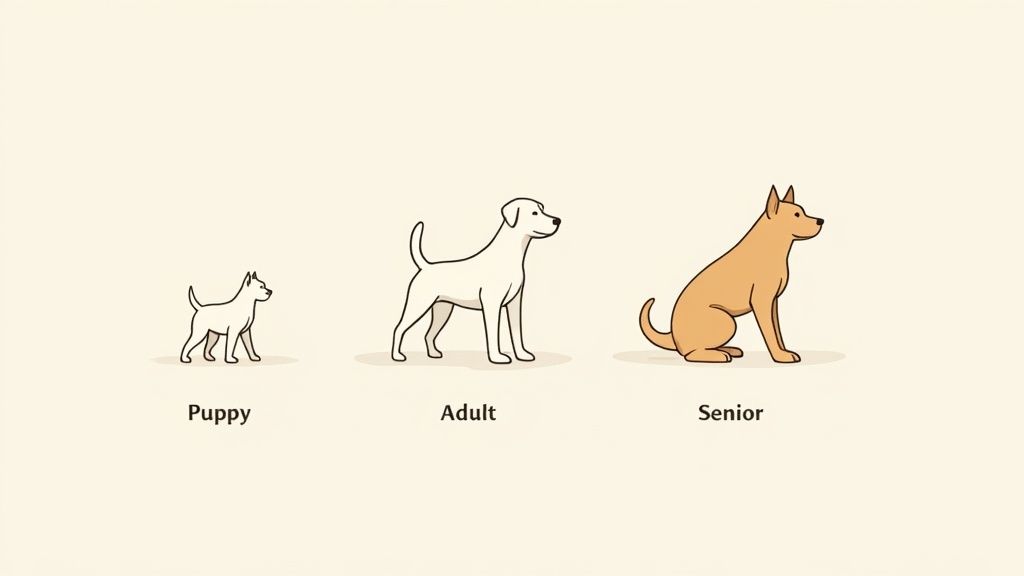
One of the most common things people worry about is a sudden change in dog behavior. But more often than not, what seems "sudden" is just the natural progression of life. Like people, dogs move through distinct life stages, and their personalities, habits, and needs evolve right along with them.
Thinking about these stages gives you a roadmap for your journey together. It helps you understand what's normal, what to expect next, and how to best support your furry friend. After all, you wouldn't expect a toddler to have the same self-control as a teenager, and the same logic applies to our dogs.
The Puppy Phase: A Bundle of Energy and Chaos
Ah, puppyhood. It's a whirlwind of boundless energy, needle-sharp teeth, and an attention span that barely registers. A puppy’s main job is to explore the world, and they do that almost entirely with their mouths. This is the root of all that chewing, nipping, and taste-testing of everything from your shoes to the furniture.
Their brains are like little sponges, soaking it all in, but they have zero impulse control. This is why training can feel so frustrating—one step forward, two steps back. One minute they nail the "sit" command, and the next they're chasing a leaf as if you've completely vanished. Don't worry, this is perfectly normal.
The Rebellious Teenage Months
Just when you’ve survived the puppy chaos, adolescence slams the door. This phase usually hits somewhere between six and eighteen months, and believe me, it’s the doggy equivalent of the rebellious teenage years. That perfectly trained pup might suddenly pretend they've never heard a command in their life.
They're pushing boundaries, just like human teens do. Hormones are raging, making other dogs and every new smell on the block far more interesting than you are. This is when you'll likely see a spike in certain behaviors:
Selective Hearing: The "come" command suddenly becomes optional when there's something better to investigate.
Boundary Pushing: They might start jumping on counters they always ignored or pulling on the leash with newfound determination.
A Second Wind: It can feel like they have even more energy than they did as a tiny puppy.
This stage demands a deep well of patience. It’s not about them forgetting their training; it’s about them testing the rules. Consistency is your absolute best friend here.
Adulthood and Settling In
After navigating the choppy waters of adolescence, most dogs finally settle into adulthood, typically between the ages of two and four. By now, their personalities are pretty well-formed, their energy is more predictable, and they know the house rules (even if they still choose to bend them sometimes).
That said, a change in dog behavior can still pop up. Big life events, like a move or a new baby, can cause stress and bring out different sides of their personality. This is the stage where you get to see who they’ve truly grown up to be.
"Puppies were more excitable but less aggressive than adults, though they were harder to train due to their developmental stage."
This little nugget comes from a massive study on how dog behavior changes over a lifetime. It perfectly captures what we see every day—puppy antics are all about learning and exploring, not being "bad." If you're a data nerd, you can dive deeper into how dog behavior shifts with age in the full article.
The Golden Years: Grace and New Challenges
Finally, we arrive at the senior years. Just like us, older dogs start to slow down. Physical issues like arthritis, hearing loss, or cloudy vision start to creep in, and these physical changes almost always trigger behavioral ones.
A senior dog who suddenly gets grumpy might be dealing with chronic pain. A dog who seems lost in corners or confused could be showing signs of Canine Cognitive Dysfunction (CCD), which is very similar to dementia in humans. They might become clingier or more anxious, simply because their senses aren't as sharp as they used to be. Supporting them through their golden years is all about patience, compassion, and making small adjustments to keep them comfortable.
When Your World Changes, Theirs Does Too
Here at the daycare, we see it all the time. A family comes in, completely mystified because their once-calm dog has started acting out. After we've ruled out any health or age-related issues, I'll often ask, "So, what's changed in your life recently?" More often than not, that’s where we find the real culprit.
Dogs are the ultimate creatures of habit. They build their entire sense of security around routine and predictability—they know the sound of your car in the driveway, the time of their evening walk, and exactly where that perfect sunbeam will be at 3 PM. When our world gets shaken up, their stable, predictable one gets turned upside down right along with it.
This upheaval is a massive trigger for a change in dog behavior. Think of their routine as the sturdy walls of their house. When you suddenly move a wall, the whole structure can feel wobbly and unsafe to them.
Common Life Changes That Rattle Dogs
Even changes we see as positive can be incredibly disorienting for our dogs. From their perspective, a new family member isn't just a joy—it's a strange-smelling person who makes new noises and, worst of all, takes up your attention.
Some of the most common triggers we see include:
Moving to a new home: This is a big one. Suddenly, all the familiar sights, sounds, and smells are gone. They have to re-learn everything, from where the potty spot is to which neighborhood sounds are normal.
A new baby or partner: The whole family dynamic has shifted. Your dog might feel they're no longer the center of attention, and their schedule is almost certainly thrown into chaos.
A change in your work schedule: If you suddenly start working from home or, conversely, head back to the office, their daily rhythm is completely disrupted. This is a very common reason we see anxieties like separation anxiety develop. For owners struggling with this, our guide on how to reduce dog separation anxiety has some practical tips.
Adding another pet: A new dog or cat in the house changes the entire social structure.
Rearranging the furniture: It sounds so minor to us, but for a dog, it can feel like waking up in a completely different room.
Interestingly, while even small shifts can affect them, dogs are also incredibly resilient. For example, a comprehensive study found that despite the massive disruptions in human life during the COVID-19 pandemic, dogs' overall behavioral profiles stayed surprisingly consistent. The study did, however, note that dogs enrolled after 2020 had lower trainability scores, which might suggest changes in how people were socializing and training their "pandemic puppies." You can learn more about these fascinating findings on dog behavior during the pandemic directly from the researchers.
How to Help Your Dog Through a Transition
So, how can you help? The key is to create as much predictability as you can, even when life feels chaotic. Your goal is to be their anchor, providing a sense of normalcy when everything else feels strange.
Think of it like this: If you're lost in a new city, having a reliable map and a familiar friend makes all the difference. For your dog, routine is that map, and you are that friend.
During times of change, try your best to maintain their core schedule. Keep meal times, walk times, and potty breaks as consistent as possible. These moments become reliable signposts in their day, which helps them feel much more secure.
It also pays to be proactive. If you know a big change is coming, like a move or a new baby, start preparing them in advance. Introduce new sounds and smells gradually. Most importantly, give them extra patience and reassurance. A little more playtime or a few quiet cuddle sessions can go a long way in reminding them that even though things are different, they are still safe and very much loved.
Decoding Common Behavioral Problems
Alright, let's talk about those moments when a shift in your dog's behavior feels like more than just a weird phase. Here at the daycare, we see the whole spectrum of dog personalities, and we’ve learned one thing for sure: these bigger behavioral issues are just your dog's way of trying to communicate a deep-seated emotion. Figuring out what they're really saying is the most critical first step.
Think of it like a baby crying. They cry for all sorts of reasons—hunger, being tired, discomfort. We don't just label the baby as "bad"; we get curious and try to figure out what they need. A dog's behavioral problem is the exact same thing. Barking, growling, or hiding are just the outward symptoms of an underlying feeling, like fear, anxiety, or insecurity.
When we start decoding these common issues, we’re not just trying to put a stop to a behavior. We’re trying to understand the root cause so we can help our dogs feel safe, secure, and understood again.
Separation Anxiety: The Fear of Being Alone
One of the most frequent issues we hear about from pet parents is separation anxiety. This isn't just a little sadness when you grab your keys; for the dog, it's a full-blown panic attack. A dog with true separation anxiety is convinced they’ve been abandoned, and their behavior reflects that sheer terror.
You might come home to find chewed-up door frames, desperate claw marks on the windowsills, or get texts from neighbors about non-stop barking and howling. These aren't acts of spite. They are frantic, instinctual attempts to escape and find you, or simply vocalizations of extreme distress.
This is an incredibly common struggle. In fact, a massive study from Texas A&M University involving over 43,000 dogs found that a staggering 99.12% of them showed at least one behavioral issue. The most common? Separation and attachment behaviors, seen in 85.9% of the dogs. This covered everything from restlessness and pacing to the destructive behaviors so many owners know all too well. You can discover more insights about these common dog behaviors in the full study breakdown.
Fear-Based Behaviors and Phobias
Fear is another powerful engine behind a change in dog behavior. This often pops up in response to specific triggers, like thunderstorms, fireworks, or even the dreaded vacuum cleaner. A dog completely overcome with fear isn't being disobedient; they're in full-on survival mode.
Their behavior is designed to do one of two things: make the scary thing go away, or get them to safety. This can look like:
Hiding: Seeking shelter under a bed, in a closet, or behind the sofa.
Shaking or Trembling: An uncontrollable physical response to their fear.
Pacing or Panting: Obvious signs of extreme stress and anxiety.
Attempting to Flee: Frantically trying to bolt from the house or yard.
Seeing these actions as fear responses is absolutely key. Punishing a dog for hiding during a storm will only make them more terrified of both you and the storm. Instead, our goal should always be to provide a safe space and comfort.
Resource Guarding: Protecting What’s Important
Have you ever seen a dog suddenly freeze, stiffen their body, or let out a low growl when you get near their food bowl or a favorite toy? That's a classic case of resource guarding. It's a deeply instinctual behavior designed to protect valuable items from being snatched away.
To your dog, "valuable" can mean anything from a piece of kibble to a dirty sock they stole from the laundry. The guarding behavior itself is a warning system. It usually starts with something subtle, like a hard stare or a stiff body. If that warning is ignored, it can quickly escalate to a growl, a snarl, and eventually, a snap. For a deeper dive into these signals, check out our guide to understanding dog body language, which can help you spot the early signs.
It's crucial to understand that resource guarding comes from a place of insecurity. The dog is genuinely afraid of losing something important to them. Trying to "fix" it by taking the item away by force almost always makes the problem much, much worse.
Understanding Different Types of Aggression
Aggression is probably the most alarming change in dog behavior an owner can face. But "aggression" isn't a single personality trait; it’s a broad term for many different behaviors driven by many different emotions. It’s almost always a last resort for a dog who feels they have no other options left.
Some common types include:
Fear Aggression: The dog is scared and uses aggressive displays to create distance from the scary thing (like a stranger or another dog).
Territorial Aggression: Defending their home, yard, or car from what they perceive as intruders.
Pain-Induced Aggression: Lashing out when touched on a sore spot, just as we discussed in the health section.
Identifying the specific type of aggression is the first real step toward addressing it. Each one requires a different approach, but they all start with recognizing that the dog is reacting to a perceived threat. Once you can identify the underlying emotion—be it fear, anxiety, or pain—you can begin to work on the root of the problem instead of just punishing the symptom.
Your Action Plan for Helping Your Dog
You've done the hard work of observation. After noticing a change in your dog's behavior and getting the all-clear from your vet, you've started to connect the dots. Now what? This is where we pivot from detective work to actively helping our dogs get back on their feet, emotionally speaking.
As a doggy daycare owner, my first piece of advice is always the same: go back to the basics. It’s like building a house—you need a solid foundation before you can start decorating. For a dog, that foundation rests on three simple but powerful pillars: a consistent routine, plenty of physical exercise, and a little bit of brain work. Nailing these three can resolve a surprising number of behavioral bumps in the road.
Back to the Fundamentals
Let’s start with routine. Dogs thrive on predictability. They don't have a schedule on their phone, but their internal clocks are incredibly accurate. Knowing when to expect meals, walks, and bedtime gives them a sense of stability, which is a powerful antidote to stress and anxiety.
Next, we have physical exercise. This is so much more than a quick trip to the backyard. It's about giving them an outlet to just be a dog—to sniff all the smells, stretch their legs, and explore their world. A tired dog is a happy dog, largely because they don't have a bunch of extra energy to pour into anxious or destructive habits.
Finally, let's not forget about their minds. A bored dog will inevitably find their own entertainment, and you probably won't like what they come up with. Mental stimulation is just as crucial as a good run. Things like puzzle toys, snuffle mats, or even a quick 5-minute training session can make a huge difference.
Knowing When to Call for Backup
Sometimes, the basics aren't enough. If your dog's behavior is severe, getting worse, or feels like more than you can safely handle, it's time to bring in a professional. There's absolutely no shame in asking for help. The tricky part can be figuring out who to call, since the titles can get confusing.
Here’s a simple breakdown of the experts who can help:
Professional Title | What They Do | Best For... |
|---|---|---|
Dog Trainer | Teaches skills and good manners like sit, stay, and walking nicely on a leash. | Everyday training, puppy socialization, and minor issues like jumping or pulling. |
Certified Animal Behaviorist | Digs into the "why" behind complex behaviors like anxiety, fear, and aggression. | Deep-seated problems like severe separation anxiety, resource guarding, or fear-based reactions. |
Veterinary Behaviorist | A veterinarian with specialized training in behavior. They can diagnose and prescribe medication if needed. | The most complex cases, especially when medical and behavioral problems overlap, like severe phobias or aggression. |
Finding the right professional is key. Always look for someone who uses positive reinforcement techniques and holds certifications from well-respected organizations.
Remember, the goal isn't to "fix" a bad dog, but to help a good dog who is struggling. Patience, empathy, and a clear plan are your best friends here. With the right approach—and the right help when you need it—you can guide your dog back to being their happy, confident self.
A Few Common Questions I Hear at the Daycare
As a doggy daycare owner, I've had countless conversations with loving pet parents who've noticed something's a little "off" with their dog. They’re worried, and they have questions. Here are a few of the ones I hear most often, along with my take on them.
Can My Dog’s Food Really Change Their Behavior?
You bet it can. Think about how you feel after eating something that doesn't agree with you—you're probably not at your best, right? It's the same for dogs. A sudden food switch can easily lead to an upset stomach, making your dog feel crummy and act grumpy or sluggish.
But it goes deeper than just an upset tummy. The actual ingredients—the balance of proteins, fats, and carbs—can directly influence your dog's energy levels and even their mood. If you've recently changed their diet and are seeing a new behavior pop up, it’s definitely worth a chat with your vet to make sure the new food is a good match.
How Do I Know if a Behavior Change Is Serious Enough for a Vet Visit?
When you're trying to decide whether to call the vet, I always tell people to remember the three D's: Drastic, Distressing, or Dangerous.
Is the change drastic? A sweet, social dog that suddenly starts growling at everyone is a huge red flag.
Is the behavior distressing? If your dog is whining constantly, hiding, or showing other clear signs of pain or anxiety, they're telling you they're suffering.
Is it dangerous? Any behavior that puts your dog, other animals, or people at risk warrants an immediate call.
Honestly, even for smaller, more subtle shifts, it never hurts to err on the side of caution. A quick check-up can provide peace of mind or catch a problem early.
How Long Should I Wait Before Calling a Trainer or Behaviorist?
First things first, always rule out medical issues with your vet. Once you have the all-clear from them, don't wait around hoping the problem will just disappear on its own.
If you've been working on the behavior for a week or two and aren't seeing any improvement (or it's getting worse), it's time to bring in a professional. The longer a new, unwanted behavior goes on, the more it becomes a habit. Early intervention is always the best approach to getting your happy, well-behaved dog back.
At Pawcation, we're all about your dog's well-being. If you're near King of Prussia, PA, and need a place that gets it, you can learn more about our daycare and boarding services here.
Comments